
Chironji 1Kg Charoli Nuts (Buchanania Lanzan) – Premium Chironji Almondette



From the same category


Chironji 1Kg Charoli Nuts (Buchanania Lanzan) – Premium Chironji Almondette
Chironji 1Kg | Charoli Nuts (Buchanania Lanzan) | Premium Almondette
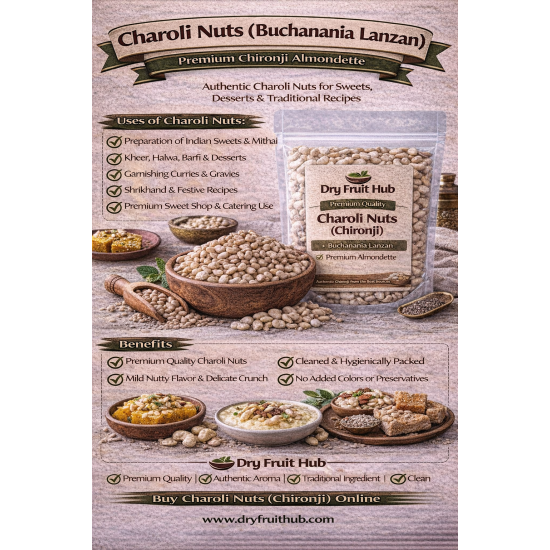
Chironji bought loose from the market often loses its delicate, almond-like flavour quickly if it isn't kept fresh — and inconsistent sizing makes garnishing look uneven. Dry Fruit Hub Chironji 1kg is carefully sourced and cleaned to preserve its mild nutty flavour, delicate texture, and natural aroma. Scientifically known as Buchanania Lanzan and widely called Charoli across India, these small kernels are a prized ingredient in kheer, halwa, barfi, and shrikhand — free from artificial colours and preservatives.
What Makes Dry Fruit Hub Chironji Different
- ✅ Carefully Sourced & Cleaned — consistent size and colour
- ✅ Mild Nutty Flavour with a Delicate, Almond-Like Crunch
- ✅ Authentic Buchanania Lanzan — not a substitute or filler mix
- ✅ No Added Colours or Preservatives
- ✅ Suitable for Home Kitchens, Sweet Shops & Professional Use
- ✅ Hygienically Packed in an ISO Certified Facility
How We Source & Clean Our Chironji
With over 20 years in the dry fruits and nuts trade from Begum Bazar, Hyderabad, Dry Fruit Hub sources chironji kernels and cleans them carefully before packing. Chironji loses its flavour and turns bitter quickly when left exposed to air, so freshness at the point of packing matters more than for most nuts. What goes into your 1kg pack is checked for consistent size and colour, giving you fresh, uniform, authentic charoli every time.
Chironji vs Almonds vs Cashews — Where Does It Fit in Your Kitchen?
| Type | Size | Taste & Texture | Best For |
|---|---|---|---|
| Chironji (Charoli) | Small, lentil-sized | Mild, nutty, delicate | Garnishing kheer, halwa, barfi, shrikhand |
| Almonds (Badam) | Medium | Crunchy, mildly sweet | Daily snacking, milk, general cooking |
| Cashews (Kaju) | Medium-large | Creamy, buttery | Gravies, sweets, snacking |
Chironji — Known By Different Names
| Hindi | चिरौंजी / चारोली (Chironji / Charoli) |
| Telugu | చారుమామిడి / సారపప్పు (Charumamidi / Sarapappu) |
| Tamil | சாரப்பருப்பு (Saara Paruppu) |
| English | Charoli Nuts / Almondette / Cuddapah Almond |
Who Should Buy This Pack
- Home cooks preparing traditional Indian sweets like kheer, halwa, and shrikhand
- Sweet shops and halwai businesses needing consistent bulk quality for mithai
- Caterers garnishing festive dishes and premium desserts
- Anyone buying in bulk for regular festive or business use
Perfect for: Kheer & Halwa | Barfi & Festive Sweets | Shrikhand | Garnishing Curries & Gravies | Sweet Shop & Catering Use
How to Use Chironji — Best Practices
⚠️ Note: Chironji loses flavour and turns bitter if left exposed to air — store airtight and use within a reasonable time after opening.
- Lightly Roast: Dry roast chironji briefly to enhance its nutty aroma before adding to dishes.
- Garnish Desserts: Sprinkle whole or chopped chironji over kheer, halwa, or shrikhand just before serving.
- Use in Sweets: Mix into barfi or festive sweet batter for a subtle crunch and authentic flavour.
- Store Airtight: Keep in an airtight container in a cool, dry place away from direct sunlight.
Easy Ways to Use Chironji
Idea 1: Shrikhand with Chironji
Whisk hung curd with sugar and cardamom, then top with a sprinkle of roasted chironji and a few saffron strands for a festive shrikhand.
Idea 2: Classic Kheer Garnish
Lightly roast chironji in ghee and sprinkle over rice or vermicelli kheer just before serving for added texture and aroma.
Nutritional Information (Approx.)
| Nutrient | Per 100g | Per Serving (10g / 1 tbsp) |
|---|---|---|
| Energy | ~580 kcal | ~58 kcal |
| Protein | 19g | ~1.9g |
| Total Fat | 50g | ~5g |
| Carbohydrates | 11g | ~1.1g |
| Dietary Fibre | 3.8g | ~0.4g |
| Calcium | Present | — |
| Iron | Present | — |
*Values are indicative averages and may vary slightly by batch. Chironji is typically consumed in small garnishing quantities rather than as a primary nutrition source. Not intended as medical or dietary advice.
⚠️ Usage Note
People with tree nut or seed allergies should exercise caution with chironji and consult a doctor if unsure about any reaction. Chironji is calorie and fat-dense — those managing weight or fat intake should use it in small, garnishing quantities as is traditional. This product is not a substitute for medical or dietary advice — please consult a physician or dietitian for personalised guidance.
Explore more: Chironji 250g | Chironji 500g | Saffron (Kesar) 4g
❓ Frequently Asked Questions
Q1. What is Chironji (Charoli)?
Chironji, scientifically called Buchanania Lanzan, is a small, lentil-sized kernel with a mild, almond-like flavour, widely used in Indian sweets and desserts. It's also called Almondette or Cuddapah Almond in English.
Q2. What is the difference between chironji and almonds?
Chironji is much smaller, with a milder, more delicate flavour, and is mainly used in small garnishing quantities in sweets, while almonds are larger and more commonly eaten as a daily snack — see the comparison table above.
Q3. Why is chironji expensive compared to other nuts?
Chironji is labour-intensive to harvest — the kernels must be manually extracted from the hard outer shell of the fruit, which contributes to its higher price compared to more easily processed nuts.
Q4. How should chironji be used in cooking?
Chironji is typically lightly roasted to enhance its aroma, then used to garnish kheer, halwa, barfi, and shrikhand, or mixed into sweet batters for added texture.
Q5. Why does chironji sometimes taste bitter?
Chironji loses its flavour and can turn bitter if left exposed to air for too long. Storing it airtight in a cool, dry place helps preserve its fresh, nutty taste.
Q6. How should chironji be stored?
Store in an airtight container in a cool, dry place away from direct sunlight and moisture to preserve its flavour and prevent bitterness.
Q7. What is the shelf life of chironji?
When stored correctly in an airtight container, chironji typically stays fresh for 6-9 months from the date of packing.
Q8. Can chironji cause allergies?
People with tree nut or seed allergies should exercise caution with chironji and consult a doctor if unsure about any reaction.
Q9. Is chironji used in any traditional remedies?
Chironji has a long history of use in Ayurvedic and traditional Indian preparations, though it is sold here purely as a culinary ingredient — please consult a qualified practitioner for any therapeutic use.
Q10. Can chironji be eaten raw?
Yes, chironji can be eaten raw, though it's more commonly lightly roasted first to bring out its nutty aroma before being used in dishes.
Q11. How is quality checked before packing?
Each batch is checked for consistent size and colour, and cleaned before packing to ensure freshness. See "How We Source & Clean" above.
Q12. Is chironji suitable for sweet shop and bulk business use?
Yes — this 1kg pack is well-suited for sweet shops, caterers, and bulk kitchens. For larger requirements, check our Bulk Business Enquiry category.
Q13. Can chironji be used for garnishing curries and gravies?
Yes — chironji's subtle crunch and elegant appearance make it a popular garnish for premium curries and gravies, in addition to its more common use in sweets.
Q14. What is chironji called in Hindi, Telugu and Tamil?
Hindi: Chironji / Charoli (चिरौंजी / चारोली). Telugu: Charumamidi / Sarapappu (చారుమామిడి / సారపప్పు). Tamil: Saara Paruppu (சாரப்பருப்பு).
Q15. What is chironji's scientific name?
Chironji's scientific name is Buchanania Lanzan, a tree native to India known for these prized kernels.
Q16. Is this product free from added colours or preservatives?
Yes — Dry Fruit Hub Chironji is 100% natural, with no added colours or preservatives.
Q17. Can chironji be used in shrikhand?
Yes — chironji is a classic garnish for shrikhand, adding a subtle crunch alongside saffron and cardamom.
Q18. What does chironji taste like?
Chironji has a mild, nutty flavour somewhat similar to almonds, but softer and more delicate in texture.
Q19. Can chironji be ground into a paste?
Yes — chironji is sometimes ground into a paste and used to flavour or thicken certain traditional preparations.
Q20. Is this product ISO and FSSAI certified?
Yes — Dry Fruit Hub operates from an ISO 22000:2018 and ISO 9001:2015 certified facility and is FSSAI licensed (License No. 10019047001430).
Q21. Do you offer free shipping on this product?
Yes — we offer free shipping on orders over Rs.599. Please check the checkout page for current shipping details to your location.
About Dry Fruit Hub: Headquartered in Begum Bazar, Hyderabad — one of India's oldest and most trusted dry fruit markets — Dry Fruit Hub has been sourcing and delivering premium quality dry fruits, nuts, seeds, and spices for over 20 years. ISO 22000:2018 & ISO 9001:2015 Certified. FSSAI Licensed. Trusted by households and businesses across India.